



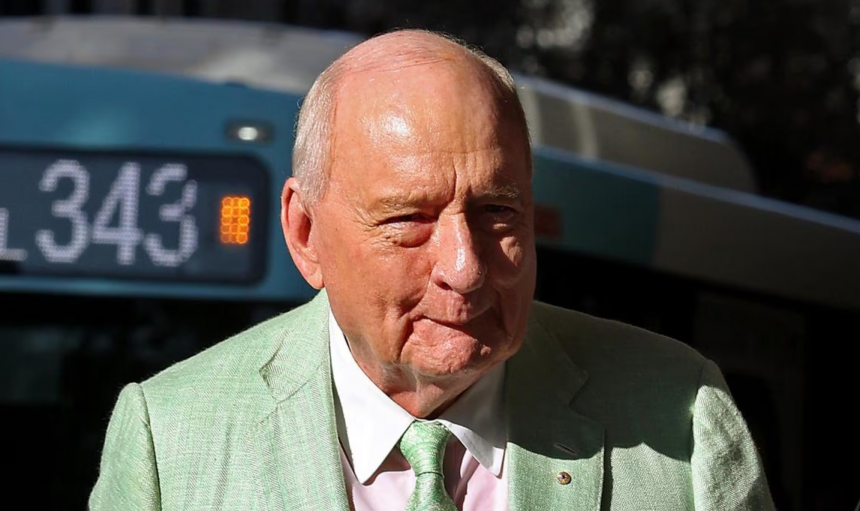
For decades, Alan Jones occupied a uniquely influential position in Australian media. As a broadcaster, commentator, former rugby coach, speechwriter, and public figure, he became one of the most recognizable voices in Australian talkback radio. His career demonstrated the extraordinary political and cultural influence that radio personalities could accumulate before social media transformed the information landscape. Supporters viewed him as an outspoken advocate willing to challenge governments and powerful institutions, while critics argued that his style contributed to increasingly combative political debate. Whatever perspective one takes, it is difficult to understand the history of Australian talkback radio without considering the role Jones played in shaping it.
Born in Queensland in 1941, Jones did not follow a straightforward path into broadcasting. His early professional life included teaching, political work, and involvement in sport. One of the most significant chapters came through rugby union, including his time coaching the Australian national team. Coaching at an elite level requires communication, authority, strategy, and the ability to motivate individuals under intense public pressure. These qualities would later become recognizable features of his broadcasting persona, although the arena shifted from sport to politics and public affairs.
Jones also worked in politics before becoming one of the media figures most capable of influencing political conversations from outside Parliament. His experience included working as a speechwriter for Prime Minister Malcolm Fraser. This gave him firsthand familiarity with political communication and the way governments attempt to frame arguments for the public. When Jones later became a talkback host, he therefore approached politics not simply as an outside observer but as someone who understood the machinery of political messaging.
Radio ultimately became the platform that transformed him into a national public figure. Talkback radio is a distinctive medium because it creates an unusual sense of intimacy between host and listener. Television personalities appear inside a visual production, surrounded by sets, graphics, and cameras. Radio hosts speak directly into the listener’s private environment—in a car, kitchen, workplace, or bedroom. Successful presenters can therefore develop relationships with audiences that feel remarkably personal. Regular listeners may hear the same voice every morning for years, eventually treating the host as a familiar presence rather than a distant celebrity.
Jones proved exceptionally effective within this format. His broadcasting style was forceful, opinionated, emotionally direct, and often confrontational. Rather than presenting himself as a neutral moderator, he openly argued positions and challenged politicians, business leaders, bureaucrats, and other public figures. This approach helped him develop a loyal audience because listeners rarely had difficulty understanding what he believed. It also made him intensely polarizing. People who shared his views could see him as someone articulating frustrations ignored by mainstream institutions, while opponents could view the same broadcasts as evidence of excessive media influence.
His ability to communicate directly with political leaders was particularly important. Senior politicians understood that an appearance on a highly rated talkback program could reach large numbers of voters. A difficult interview could dominate the political news cycle, while support from a prominent broadcaster could amplify a policy or campaign. This relationship between media and politics was not unique to Jones, but his prominence made him one of Australia’s clearest examples of how a broadcaster could become a political actor without ever holding elected office.
Jones frequently used his program to champion individuals or communities he believed had been treated unfairly. This advocacy was central to the loyalty many listeners felt toward him. Talkback radio can function partly as a public complaints desk, where ordinary people contact hosts after becoming frustrated with government departments, companies, councils, or other institutions. When a powerful broadcaster adopts such a case, the attention can produce results far more quickly than conventional bureaucratic channels. This ability to intervene in individual disputes helped strengthen Jones’s image among supporters as someone willing to fight for people who lacked influence of their own.
More EV News

At the same time, the enormous platform generated repeated controversies. Jones’s comments on political figures, climate change, social issues, and public policy frequently attracted criticism. Some broadcasts resulted in formal complaints or regulatory scrutiny, while others became major subjects of public debate. His career therefore illustrates both sides of personality-driven media. A strong individual voice can create extraordinary audience loyalty, but the same freedom that makes the format compelling can also generate significant consequences when commentary crosses legal, ethical, or regulatory boundaries.
The media environment surrounding Jones also changed dramatically during his career. At the height of traditional talkback radio, a relatively small number of major broadcasters could command enormous attention. Social media later fragmented that power. Political commentary is now distributed across podcasts, YouTube channels, TikTok accounts, X, Facebook, newsletters, independent websites, and countless other sources. Audiences can build personalized information environments rather than depending on a handful of dominant radio and television personalities.
Yet many features of contemporary digital commentary resemble the talkback model that Jones mastered. Strong personalities outperform institutional voices. Conflict attracts attention. Audiences develop loyalty to individual commentators. Political opinions become intertwined with entertainment. Direct relationships between hosts and followers can be more important than the reputation of the media organization distributing the content. In this sense, influential talkback broadcasters anticipated much of the creator-driven political media environment that followed.
The later chapters of Jones’s public life have been overshadowed by serious criminal proceedings. As of August 2026, he is on trial in Sydney facing multiple charges of indecent assault and sexual touching involving several complainants. Jones has pleaded not guilty and denies the allegations. Because the proceedings are ongoing, the allegations must be treated as allegations rather than established facts, and the outcome is a matter for the court. The case has nevertheless generated substantial Australian media attention because of Jones’s decades-long prominence.
This development also demonstrates the importance of separating a historical assessment of a public career from unresolved legal proceedings. Jones unquestionably played a major role in Australian broadcasting and political communication, but his legacy is also contested for reasons extending well beyond the current case. His supporters and critics have long interpreted his influence in radically different ways, and contemporary legal events add another layer to an already complicated public reputation.
From a media-history perspective, Jones belongs to an era in which radio could create personalities with extraordinary influence over national conversations. His career illustrates the power of a compelling individual voice, the intimacy of talkback broadcasting, and the complicated relationship between journalism, commentary, advocacy, and politics. It also illustrates the risks that arise when media influence becomes heavily concentrated around individual personalities.
Whether remembered primarily as a formidable broadcaster, political advocate, controversial commentator, or deeply polarizing public figure, Alan Jones has occupied an unusual place in Australian public life. His career provides a window into how media power operated before the rise of social platforms and how many of those same dynamics—loyal audiences, political polarization, personality-driven news, and conflict as entertainment—have simply migrated into new technological forms.